

擁抱正是探戈的主要魅力
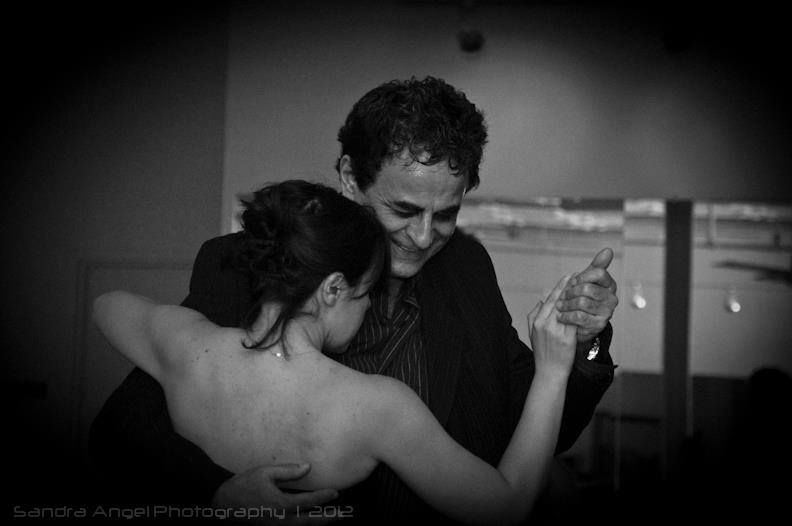
世界上很少有舞蹈崇尚擁抱。 在社會一般的習俗裡,競爭、急迫性和缺乏團結正在將社會推向危險的個人主義。 這種情況也在今日的舞蹈裡明顯地反映出來:遵循文化制約的傾向。
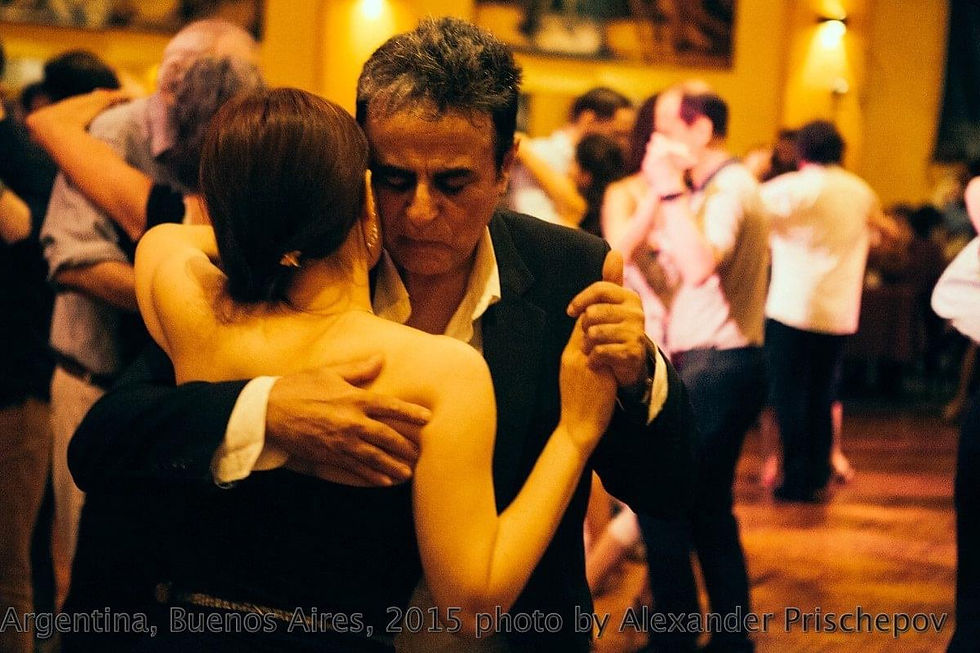
我想為你強調擁抱的重要性。 在這個缺乏情感的時代,由於無數原因,導致擁抱被拋在一邊。 但擁抱正是探戈的主要魅力。 這也是為何探戈能風靡全球、穿透不同文化藩籬的原因。
擁抱使我們回到了童年、我們早年的生活。 它使我們回到原初那種男人對女人的保護,一個雄壯的身體(男人)面對一個輕巧身體(女人)的感覺。 我甚至敢說,這當中不帶有性暗示。
許多男人透過探戈,才開始發現擁抱的重要性。 有些朋友還不知道,也不能想像擁抱的重要性。 除了一些負面例外情況,這種對擁抱的不重視,會使探戈喪失了原本的性格或本質。
在探戈裡,擁抱受到尊重。
男人是那個主動提供擁抱的角色。 他應該展開他的胸部,提供他的擁抱給女人。男人用胸部擁抱他的伴侶,這個描述並不過分。 是這樣的身體姿態,讓他跟別人不同。 透過這個姿勢,他告訴她:從這一刻起,他接受她,歡迎並保持她。 他不應該用手臂把她拉到他身邊。 他需要允許她,能在他的擁抱中尋求庇護以及安全感。 接著,他牽起起她的手,並用右手環繞她。
整個過程裡不應有暴力感。 若用細緻的心去感受,男人會了解這個女人是否接受他的擁抱。 如果她不接受,她可能會發出警告。 男人不需要用手臂使勁地抱住她。 男人只需環繞她的背部,當兩人都準備好,就可以跳舞了。
兩個人應該花幾秒鐘時間,看看雙方提供了哪種擁抱。
如果女人發現這樣的擁抱很愉快(如果男人提供的是close embrace),她就完成了擁抱。 如果她發現它不愉快或者她不知道如何在這種情況下跳舞,她則需要用一種輕快的方式,不指責地告訴舞伴: 她不舒服,他的擁抱太緊了。
==
完整全文: How to arrive to the embrace and set it in place…
by Raul Cabral
I will begin this essay by saying; few dances in the world honor the embrace. Social customs, competition, urgency and a lack of solidarity are taking societies to a dangerous level of individuality. This is obviously reflected in the way people actually dance today with modern rhythms conforming to what is culturally mandated.
It is important to inform you as to the significance of the embrace. In these times of indifference, void of affection for innumerable reasons, the embrace has been tossed aside. In tango it is it’s primary attraction. It is the reason tango has triumphed in so many and different societies of the world.
The embrace takes us back to our childhood, our first years of life. Primitively, it takes us back to man’s protection of women, the sensation of one, more imposing body, (that of the man) facing a body more slight (that of the woman). I would even venture to say, without sexual connotation.
Many men, through tango, are beginning to discover the importance of the embrace. It is fair to say, some have no idea of, nor can they imagine the importance of the embrace. In some way, considering one or another negative exceptions to my interpretation, this robs tango of its character or essence. In tango the embrace is honored.
This instrument, the embrace, as important as it is, is not the only component necessary to attain the union of the couple. As it is not, we will opportunely take up discussion of other components in future essays, but for now I wish to convey my opinion on the theme proposed.
In some classes, students ask, “Where should I hold my partner?” “How high on her back?” “How do I do it?” Of course, there are specific techniques, but this reflection is not about that.
In an attempt to be as all-inclusive as possible while bearing in mind the multitude of different embraces, I refer here to the precise moment we set the embrace, without taking into consideration the different conditions and/or physical particulars of each dancer.
Of course, there are as many embraces as there are dancers; no two embraces are exactly alike. So, why try to generalize? The answer is because there exists one condition I want to share with you, which I do believe to be global or general in nature.
While speaking with Dianne Castro in an opportune moment during a workshop in the U.S., I was struck by the coincidence of our opinions regarding this particular. The conversation gave me the impetus to prepare this essay, describing those few seconds of the embrace, gestation to concretion, clearly consisting of three distinct stages.
Stage One: Visualization
It is through visualizing we establish physical knowledge and the particulars of our partner; size, magnitude, etc. If it is a partner we already know, add affecting memory to this occurrence, the remembrance of tangos shared.
Stage Two: Physical
Here begins the language of tango without words. No one can force any one else into one’s preferred embrace, attempting they attain technically, an embrace for which they are not familiar.
The man is the one who proposes the embrace. He should spread his chest as an offering for the embrace and it is not an overstatement to say he should use his chest to embrace his partner. This gesture identifies him. Through this gesture he informs her that from that moment on, he accepts her, welcoming holding her. He should not bring her to him with his arms. He needs permit she take refuge in his embrace, finding shelter and protection, security for the dance. Afterwards, he takes her hand and finally he wraps his right arm around her.
There should never be a sense of violence in this action. With subtlety, here, the man will understand if the woman accepts his embrace as hers. If she does not, she may issue him a warning. It is not necessary to seize her using force with your arm. Simply by surrounding her back you are prepared, both ready for the dance.
Both should take a few seconds to see what kind of hug is offered by both the partner and the leader.
The woman then completes the embrace if she finds it pleasurable to do so (a close embrace, if that is what is being proposed). If she does not find it pleasurable or she does not know how to dance in this situation, in a pleasant manner, without recrimination, she needs to tell her partner that she is not comfortable, that his embrace is too strong.
Take note I say she completes the embrace when accepting it as perfect and final. And in no way should this be interpreted as capricious, nor authoritative, nor macho, nor anything that would appear to be anything of the kind.
This is a special moment of a beautiful custom. The feminine arms, raised like birds in flight, are beautiful. Weightless, with no intention of applying pressure or hanging on her partner, her arms land gently on his shoulders. The man proposes, the woman accepts. In conjunction, they concur, all in a matter of seconds. It is a delicate and elegant language made up of gesture, without words.
Now we will describe the gross reality of the situation reversely described. Imagine a woman, immediately, upon having the man face her, throwing herself on him, hanging by her arms and completely supporting her body. Or that leader, who right at the exact moment, showing no regard, chooses to pull the woman towards him, trapping her against his chest. Each of these unpleasant actions requires no further commentary.
In a close embrace, we embrace with our bodies. The feminine arms void of matter, take on an ethereal quality. Gently wrapping his arm around her, the man’s arm initiates a sense of protection, inviting her to settle into her zone of physical comfort.
Slightly inclined, body weight forward on the foot, we are supported by the entire ball and even the heels of the foot on the floor. This is the position we maintain, the position in this manner, which renders us weightless.
We make contact only through our chests (feminine & masculine); forget stereotypes or exaggerations, with each responsible for our own equilibrium or balance.
The embraces of a dance are different than the embraces of other situations in our lives; nonetheless, this dance embrace will conjure up all your most pleasant of memories.
To summarize; the dance embrace should be subtle, vital, present, real and natural, an ocean of expression, but it must allow one to dance. Contain but do not hold prisoner your partner. It is counterproductive for him to carry her or for her to throw herself on him. Do not asphyxiate and even if you are strong, do not oppress. You are the union we complete for our marvelous dance, this flight, this expression, screaming of freedom.
Since the dance of tango has become massively popular, we could say beginning in 1935 to the present, more than 70 years (I repeat, with perhaps some negative exception of my understanding of more recent times); the embrace in tango is closed and will continue to be so for most.
Despite all of this, social tango is in question with newer styles, whereby using mere words they justify a supposed communication. There is only one communication in tango and it is corporal, from body to body, not arms to arms.
Stage Three: Integration
My understanding considers this stage the most important. Everything I have described above lacks value if the integration of the couple does not exist.
In my experience as a dancer and maestro of the dance, I have embraced many women, whereby, aside from the fact we are in a close embrace, I feel they are separated from me, not with me. As well, I have many stories from many ladies, where the reverse occurs, whereby some men, even though they are in a close embrace, their energy, their bodies are abysmally distant.
Once you have accomplished the first two stages of the embrace described above, what happens in an instant next, is we enter into the third stage, integration.
I will try to describe integration using metaphors, because in this manner I assure you completely understand.
The man spreads his chest and the woman settles into him, or rather, she conforms, becoming part of the body of her leader. She transforms herself, blanketing him, dressing his torso as if she were his shirt, melting into him with subtle but assured pressure, without throwing herself upon him, or leaning.
And until the tango is over, she should have her chest permanently in contact with his, even if executing the choreography demands the torsos separate at some part or partially. It is from this point she will be led, from her leader’s chest and not from any other part of his body (feet, legs, arms or hands). If she separates from him she will loose her conductor, her dance. She should always continue to maintain contact.
Both the woman and the man should pump up their chests, without filling them with air, rather they must elevate their energy, separating and opening up space within the rib cage. This allows the bodies to expand and dance in elevated fashion, energy upwards, from the waist up.
But this position should not be exaggerated, because exaggeration tightens the bodies, rendering them rigid. This is the main reason why this should be done without taking in air using only the muscles and separating the ribs. Even if subtle, elevating the flow of energy is notoriously pleasant.
Final considerations:
By relaxing, the dancers feel free, taller, elevated, the flow of energy upward, stretching their bodies, permitting they carry out even the most committed movements.
While driving, the leaders assume their responsibility, their role, the partner affecting each of the leader’s movements without thought or analysis, just allowing they be driven. The women are, yes, relaxed, but nonetheless, need be integrated into the body of their partner.
Make note, the women are responsible for their own equilibrium, they should not pass this responsibility on to their partner, for their partners have yet other responsibilities within their role in the dance.
Forgive me if I burden you, over elaborating upon the importance of the feminine role. But if there is no integration, if the woman does not complete the embrace and if she does not mimic her leader’s movements, there is no tango. I remind you tango is synchronization. It is changing the weight of the body at the same time. Anything other than that exact circumstance, even the slightest deviation, is evident.
Synchronization is the responsibility of the person being led. When we say synchronization, we speak of exactness. It cannot be off, even minimally. My understanding of synchronization would suggest the use of the word “follow” is an incorrect reference because the word “follow” implies a moment later. Even if it seems immediate, it is not. What is correct is for the woman to enter the moving car, which is her leader, and allow herself be transported on the musical journey, no notions, only emotions, no analyzing, only feeling.
I will end with a paragraph about dancing socially. Dancing socially is not like some requisite. There is no goal you must exceed, or an exam you must pass, and it is not a sacrifice. Think, I can and should allow myself to err, I will realize and accept my mistakes and learn from them in order to correct them. Just as in life, we are all capable of mistakes; what is more important is that we not live life mistakenly.
Dance, dance and dance keeping in mind, tango is for pleasure. This should be our foremost premise. So enjoy without worry, toss aside the urgency and of course, do not pretend to resolve all the corrections you receive from your instructor, nor apply all you learn from classes during the course of one tango. Work on these one by one, one at a time, give yourself time; be happy with even your slightest progress, because even if it is a minimal difference, it will be of great benefit to you.
None of this will promise you dance better immediately; each body needs the appropriate time to mature. But you can be sure you will at least be on the right track, won’t deviate over absurd pretentions, and be correctly focused and sooner or later your dance will be appreciably better.
I give you my respect. Consider me always at your disposition.


留言